
Coir Logs
Shop our range of coir logs — natural coconut fibre erosion control logs for stabilising embankments, stream banks, slopes and newly graded areas while supporting revegetation and habitat establishment across Australian landscapes.
Coir Logs — Buying Guide
What Are Coir Logs?
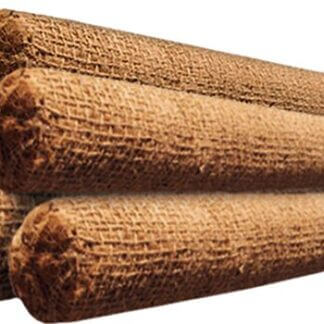
Coir logs (also known as coconut fibre logs or biorolls) are cylindrical rolls of tightly packed natural coconut husk fibre encased in a coir fibre netting. They are used as biodegradable erosion control structures to stabilise stream banks, slopes, embankments, drainage channels and newly disturbed ground while natural vegetation establishes. Unlike synthetic erosion control products, coir logs are 100% natural and biodegradable — they decompose slowly over several years as vegetation takes hold, leaving no synthetic waste in the environment.
Key Applications
- Stream bank stabilisation — positioned along water’s edge to reduce bank erosion from water flow and wave action
- Slope and embankment erosion control — installed across slopes to slow runoff, trap sediment and support plant establishment
- Drainage channel lining — used to line vegetated waterways and swales to reduce flow velocity and erosion
- Coastal dune restoration — used in beach and dune environments to trap windblown sand and support dune plant establishment
- Construction site sediment control — placed across drainage pathways to capture sediment from disturbed ground
- Revegetation support — provides a nurturing microenvironment for seeding and plant establishment on difficult sites
Available Sizes
Coir logs are available in a range of diameters (typically 200mm, 300mm, 400mm and 500mm) and standard lengths (usually 3m or 4m, though custom lengths may be available). Larger diameter logs provide greater capacity for sediment trapping and more effective flow attenuation in higher-energy environments. Select the diameter appropriate for the flow volume and slope conditions at your site.
Installation Tips
On slopes, install coir logs across the slope contour (perpendicular to the slope direction), anchoring them with wooden or steel stakes driven through the log into the ground. On stream banks, position logs at the water’s edge and secure with stakes. Partially bury the log on the uphill or upstream side for better stability. Plant through the log with appropriate native grasses and groundcovers for long-term revegetation.
Frequently Asked Questions
How long do coir logs last?
Coir logs typically last 3–5 years before decomposing, which is generally sufficient time for natural vegetation to establish and take over the erosion control function. Logs in flowing water may degrade somewhat faster.
Are coir logs suitable for use in waterways?
Yes — coir is a natural material that is safe for aquatic environments. Coir logs are widely used in riparian restoration and stream bank stabilisation projects.
Order Coir Logs Online — Australia-Wide Delivery
Order online for fast dispatch. We supply landscape contractors, civil engineers, councils and revegetation specialists across Australia. Contact us for large project quantities and pricing.